Thank you for reading till the end!
My Role
Product Designer
Team
Founder and Engineering Team
Tools Used
Figma · FigJam · Claude · V0 · Notion
Timeline
6 Months · Contract
Designed a clinical intelligence platform that connects MedTech vendors with healthcare professionals.
Nyelux is a US-based MedTech platform built to make medical-device knowledge more accessible at the point of care. I worked across the HCP and vendor experiences, designing product workflows, interfaces, and reusable patterns that made complex clinical information easier to access, understand, and act on.
What is Nyelux?
One platform. Two sides of clinical intelligence.
Nyelux connects MedTech vendors with healthcare professionals, bringing product knowledge, clinical evidence, training resources, and device support closer to the point of care.
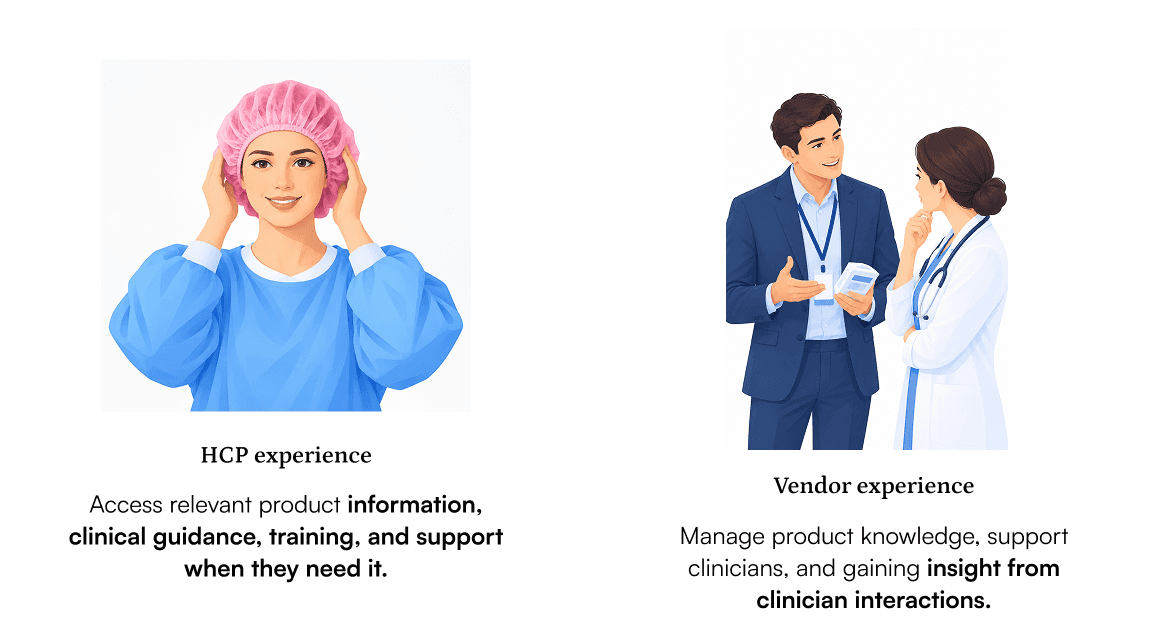
The challenge wasn't simply putting information online, it was making complex clinical knowledge easy to find, understand, and act on.
The Problem
Medical-device information was fragmented, complex, and difficult to access when clinicians needed it most.
MedTech professionals often had to move between IFUs, product documents, training materials, vendor resources, and other sources to find the information they needed. At the same time, vendors had limited ways to make their product knowledge easily discoverable and understand what clinicians were actually looking for.
The design challenge:
How might we bring these two sides together and make complex medical-device knowledge easier to find, understand, and act on?
Understanding the domain before designing
I wasn't designing for a domain I already knew.
Coming into Nyelux, I had limited exposure to the US MedTech ecosystem and the people working within it. Before designing the product, I needed to understand the space itself - how medical-device companies operate, what vendors actually do, how clinicians interact with device information, and what kind of language and expectations users bring into these products
I studied the MedTech landscape, existing healthcare products, user roles, workflows, and product conventions to understand the context behind the PRDs before translating them into interfaces.
What I needed to understand

The goal wasn't to make Nyelux “look like healthcare.” It was to understand what a healthcare product needs to communicate to feel useful, trustworthy, and easy to navigate.
Exploration with AI
01 — Exploring with V0
Wireframing & Product Structure
With complex workflows and multiple user types to account for, I wanted to explore different product structures quickly before committing to detailed UI. I used V0 to turn product requirements and early ideas into interactive wireframe directions, allowing me to test flows and identify gaps much faster.
I used V0 to translate requirements into early interface structures and explore different approaches before moving into higher-fidelity design.
02 - Iterating with Claude
Design Exploration & Refinement
I used Claude to challenge design decisions, explore edge cases, refine interactions, and iterate on the experience as the product evolved.
03 — From Ideas to a Working Prototype
Turning design direction into something I could test and interact with
I used Claude to challenge design decisions, explore edge cases, refine interactions, and iterate on the experience as the product evolved for designing for complex device hierarchies
The screen below shows a single parent medical device that can have hundreds of related child devices, variants, and instruments from the same manufacturer. For an HCP, simply finding the parent device isn't enough, they need to quickly understand which specific device they’re looking at and how it relates to other products.
I designed the experience to make this hierarchy easier to navigate, allowing HCPs to explore device variants, product information, supporting documents, and related medical devices without losing context.
The goal was to turn a complex product catalogue into a navigable clinical experience.

04 — Building a Design Foundation
Turning design direction into something I could test and interact with
As the product expanded across multiple workflows and user types, I established reusable UI patterns to keep the experience consistent and make future design iterations more efficient.
The goal was to turn a complex product catalogue into a navigable clinical experience.
05 — Designing within an NDA
The final product is under NDA
Because Nyelux is an NDA project, I can't publicly show the final product interfaces or confidential workflows. Instead, this case study focuses on the design process, decisions, and AI-assisted methods behind the work.
What I learned
This project changed how I approach complex product problems, understand the domain, explore quickly, question the output, and use AI to accelerate the work without outsourcing the design thinking faster.
01 — Domain knowledge comes before interface design
Understanding the MedTech ecosystem and its users gave me the context I needed to make better product decisions.
02 — AI accelerates exploration, not ownership
V0 and Claude helped me move faster, but evaluating ideas, making trade-offs, and deciding what was right for the product remained my responsibility.
03 — Complex products need clarity before polish
Working across different users and workflows reinforced the importance of information architecture, interaction patterns, and consistency before visual refinement.
Nyelux | MedTech Mobile Application