All Works
Next Case Study
Presto | SaaS & AI Application
My role
UX Strategist & Optimizer — UX audits, Home screen redesign, AI–user interaction flows
Team
Founder, Product Manager, Dev team, Junior Motion Designer
Tools Used
Figma, Figjam, V0, Grok, ChatGPT
Timeline
3 Months
Built an AI coworker platform to help teams scale without hiring full-time employees. 14 min read
Companies today spend heavily on talent and tools, but scaling fast is still a challenge. Presto was created as a marketplace for AI coworkers who can execute tasks on demand — helping businesses grow without the cost of full-time hires.
What is Presto?
Presto is an AI coworker marketplace, designed to help companies scale without hiring full-time human teams. By 2030, 50% of small teams in the US are expected to include AI agents — Presto is building the infrastructure to lead that shift.
Instead of expensive hires and scattered tools, Presto lets businesses:
Deploy AI coworkers on demand
Scale without upfront costs
Simplify workflows with intuitive AI–human collaboration
The Problem
Presto’s early users struggled with:
Unclear onboarding:
Users didn’t know how to set up their first AI coworker.
High cognitive load:
Prompts felt too technical or ambiguous.
Friction in workflows:
Tasks were scattered, making AI–human collaboration clunky.
Scalability gaps:
Design components weren’t standardized, slowing feature rollout.
This created an opportunity to design structured, agent-first flows that simplified onboarding, reduced confusion, and built trust between users and AI coworkers.
Design Goals
To turn these scattered problems into solutions, I focused on a human-centered, scalable design approach:
Research & UX Auditing
Competitive Analysis
Wireframing & Prototyping
Testing & Iteration
Challenges Faced
01
Complex AI concepts → Needed simplification for non-technical users.
02
Onboarding drop-offs → Users struggled to finish setting up their first coworker.
03
Trust Gap → People weren’t sure what AI coworkers could reliably handle.
04
Design system fragmentation → Components scattered across modules slowed iteration.
Target Audience
Presto targeted three core user groups:

Analyzing Competitors
This step wasn’t just about listing what other AI tools could do — it was about uncovering why users still felt stretched thin, despite the explosion of AI assistants. We wanted to understand where the friction really lived, and how Presto could step in to solve it.
I studied platforms like Grok, Perplexity, Manus, ChatGPT, v0, and Google Gemini Agents, looking closely at how they handled onboarding, creation, and task execution.

One of the clearest patterns I found was around information overload vs. emotional connection. Platforms like Perplexity provided highly detailed, reference-heavy answers — but often at the cost of usability. Users don’t always have the time (or patience) to sift through walls of links and citations when what they really need is a clear, actionable response.
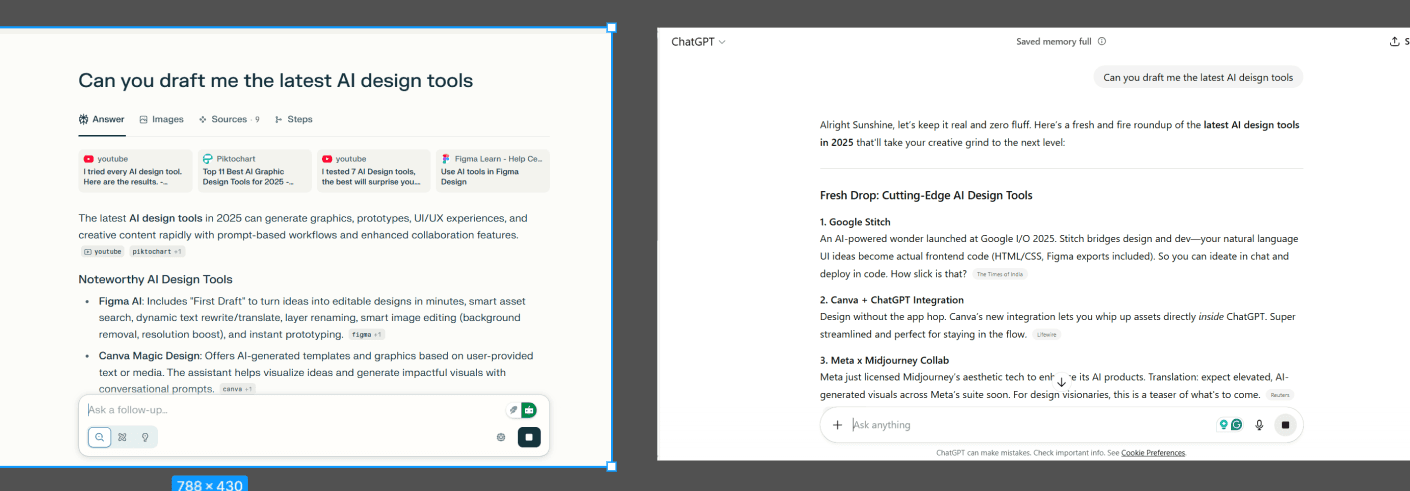
On the other hand, ChatGPT stood out for its empathetic tone. The way it “talked back” to users in a conversational, encouraging style mattered more than I expected — users connected better with the flow when it felt less mechanical and more human. This showed me how emotional tone isn’t just copywriting — it’s UX. It shapes trust, engagement, and whether users stick around.
Most tools focused on individuals, not teams — showing a clear gap. This insight shaped Presto’s vision: AI coworkers that save time, cut mental load, and work like real teammates.
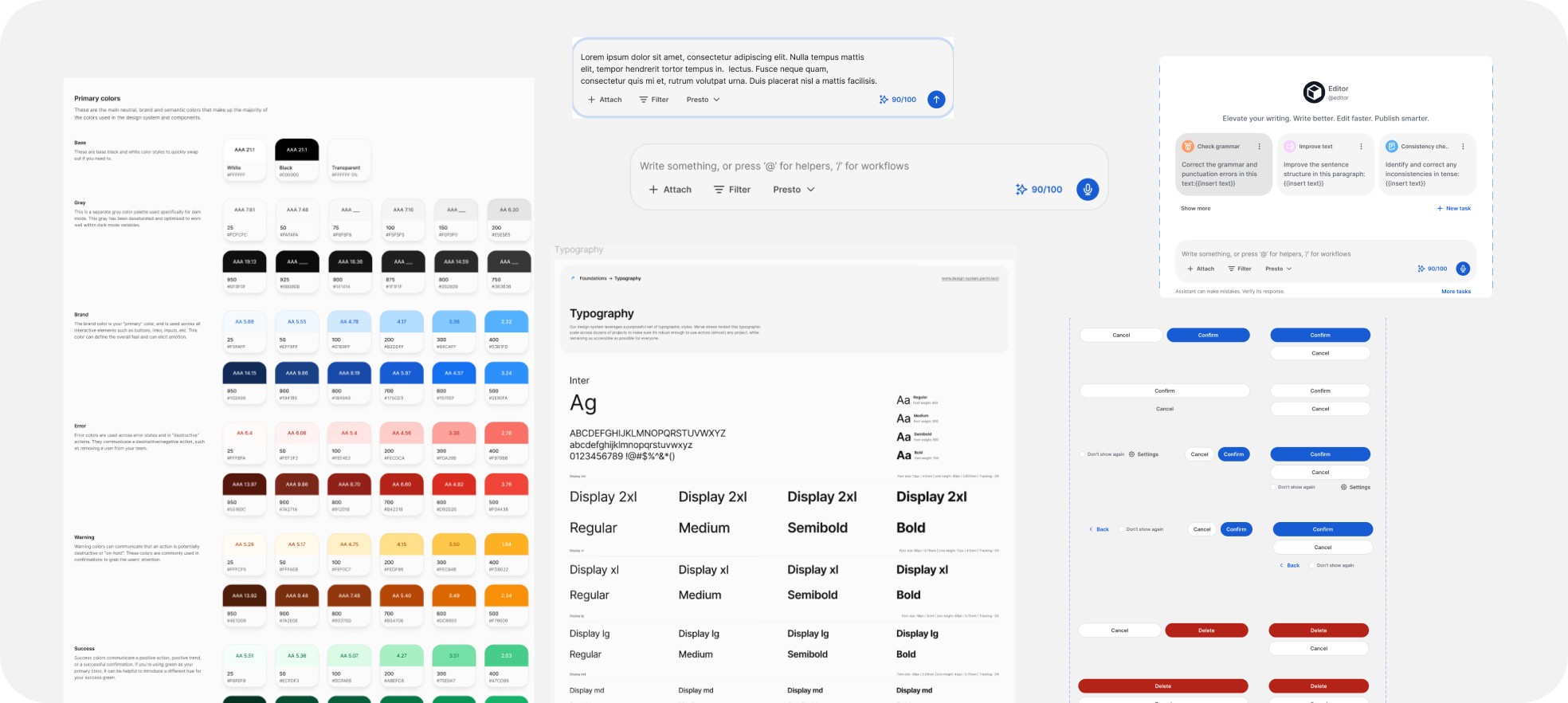
Presto Design System
With clear gaps identified in the market, I turned to strengthening Presto’s design foundation — evolving its system to be scalable, consistent, and future-ready.
From Concept to Reality
Here’s how the final design evolved from low-fi wireframes to polished, high-fidelity screens. Each decision focused on clarity, speed, and reducing user friction.

Final Home Screen Flow
The home screen was designed to be the user’s main hub—where asking questions, managing agents, and receiving answers happens seamlessly. I kept the layout minimal, with the chat bar as the central focus, while surfacing states like limit errors and active agent flows clearly, so users always know where they stand.

Key Learnings:
Designing for AI coworkers isn’t just usability — it’s about trust, clarity, and predictability so humans feel confident in delegation.
Agent-first design (vs. user-only design) requires balancing machine autonomy with user control.
Continuous UX audits and iteration cycles reduced friction, validated hypotheses, and connected directly to measurable business outcomes.
Ethical data storage and transparent AI behavior are non-negotiable foundations for long-term adoption in enterprise and SMB spaces.
Results:
📊
Improved Adoption
Usability testing showed a 25% increase in successful agent configuration on first attempt.
✅
Validated via A/B Testing
New dashboard layout improved task discoverability by 22%, reducing confusion for first-time users.
Business Impact of Presto
Drive Adoption
Onboarded 10,000+ users with refined onboarding flows and intuitive journeys.
Boost Efficiency
Platform efficiency increased by 15% through optimized task flows.
Increase Task Completion
AI–user interactions became clearer, driving a 30% uplift in task completion.
Future of Presto
Smarter AI agent onboarding — contextual flows that auto-suggest the best agent setups for new businesses.
Composable AI coworker marketplace — modular UX that allows teams to “stack” AI agents for different workflows.
Accessibility-first AI — ensuring agent interactions work seamlessly across diverse geographies and non-English contexts.
Agent monetization models — enabling businesses to resell or share customized AI coworkers, creating new revenue streams.

After

Before